
Part 2: Beyond the Database: How CRM Systems Build Social Capital in Destination Organizations
In Part One of this series, we explored how CRM systems serve as the digital infrastructure of structural social capital. If you’d like a recap of the first post, feel free to check that out here.
We examined how platforms such as Granicus and Tempest IDSS help destination organizations create visibility into their stakeholder networks, institutionalize relationships, improve information flow, and identify gaps in engagement. In short, we established that CRM systems are far more than databases—they are the foundation upon which destination networks are built.
But even with the underlying structure in place, that’s not quite enough and we just don’t stop there..
The true value of structural social capital emerges when organizations use that infrastructure to create new connections, facilitate collaboration, and strengthen the broader destination ecosystem. In this second installment, we will explore how CRM systems can help destination organizations foster bridging social capital, support co-creation among stakeholders, measure the health of their networks, and leverage emerging technologies such as artificial intelligence to strengthen—not replace—the human relationships that drive destination success.
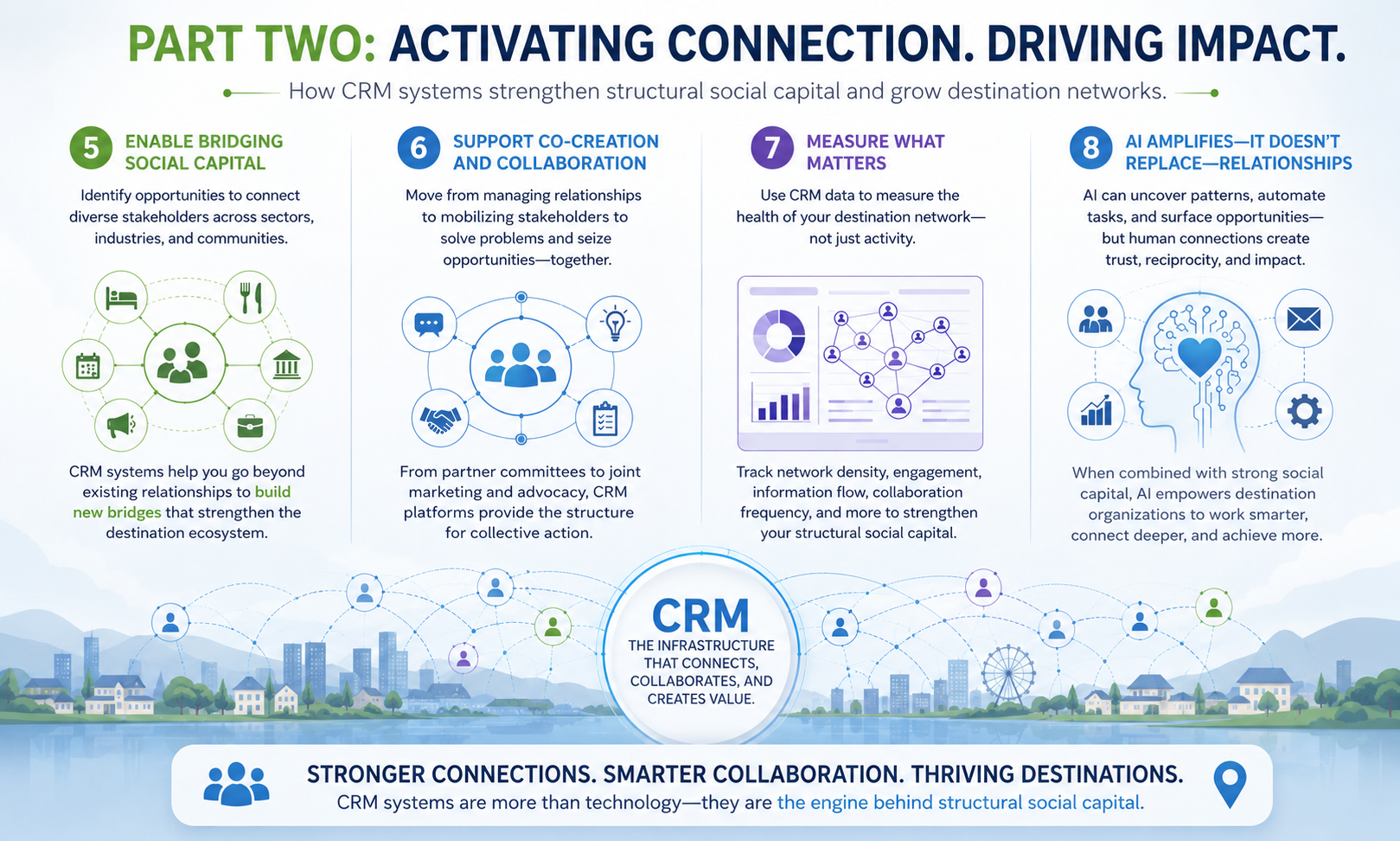
The role of CRM Systems in building structural social capital.
Point 5: CRM Systems Enable Bridging Social Capital
Bridging social capital occurs when diverse groups connect.
CRM systems help identify opportunities to connect:
Hotels with attractions
Restaurants with event planners
Minority-owned businesses with destination initiatives
Convention clients with local partners
Without technology these opportunities are often missed.
With technology they become intentional.
Point 6: CRM Systems Support Co-Creation
Many DMOs still use CRM systems primarily as databases.
The more advanced use is facilitating collaboration.
Examples:
Partner committees
Working groups
Destination stewardship initiatives
Advocacy efforts
Joint marketing campaigns
The CRM becomes a platform for collective action.
This is where structural social capital moves beyond connectivity into collaboration.
Point 7: Measuring Social Capital Through CRM Data
Interesting section for thought leadership.
Traditional CRM metrics:
Number of contacts
Number of accounts
Email opens
Membership counts
Social capital metrics:
Network density
Stakeholder participation
Cross-sector engagement
Weak tie development
Information flow velocity
Collaboration frequency
Future-ready DMOs will use CRM data not simply to measure activity but to measure network health.
Point 8: AI Doesn’t Replace Social Capital—It Amplifies It
Tie this to a contemporary topic.
As AI becomes embedded in destination organizations:
AI can automate communications
AI can identify patterns
AI can recommend opportunities
But AI cannot create trust. AI cannot create reciprocity. AI cannot create stakeholder commitment.
CRM systems combined with AI become more valuable when strong social capital already exists.
So that’s all for this series for now. As you can see from the following two posts, Destination Organizations have a sleeping giant if you will at their disposal via their internal CRM software platforms. The role of the CRM has evolved in recent years from simply a data repository, to a mechanism to unlock deeper knowledge of the stakeholder audiences and serve them better.
Is your DMO taking full advantage of these opportunities?
