

Part 1: Beyond the Database: How CRM Systems Build Social Capital in Destination Organizations
We have discussed before how social capital can help destination marketing organizations reach their organizational goals. We have also explored the three primary dimensions of social capital: structural, relational, and cognitive. In this two-part series, we will build on those ideas by focusing specifically on structural social capital and, more importantly, the role that CRM and similar systems play in helping DMOs create a stronger infrastructure for connection, collaboration, and stakeholder engagement.
As discussed on the Insightful Moments Podcast, structural social capital is not simply about who knows whom. It is the architecture that allows relationships to form, information to flow, and collaboration to occur. In modern destination organizations, CRM systems serve as the digital infrastructure that makes structural social capital visible, manageable, and scalable.
Many of us, myself included, have traditionally thought of the CRM as a database: a place where information about members, groups, events, accounts, and contacts is housed. That view is not necessarily wrong, but it is incomplete.
What if we looked at the CRM not simply as a database, but as the social infrastructure of the destination organization and, ultimately, the broader destination community?
This way of thinking comes down to one thing: structure.
CRM systems provide the foundation for how a destination organization creates, supports, and strengthens a network of interconnected organizations across a geographic area. When we think more deeply about structure, especially as it relates to social capital, several key ideas begin to emerge:
Who is connected to whom?
How often do stakeholders interact?
Where does information flow?
Which organizations are isolated?
Who has access to destination opportunities?
In answering the questions above, CRM systems have to provide the underlying architecture. Over the rest of this and the following blog post, we will go over 8 specific points to expand upon our ideas here as it relates to structural social capital via the CRM.
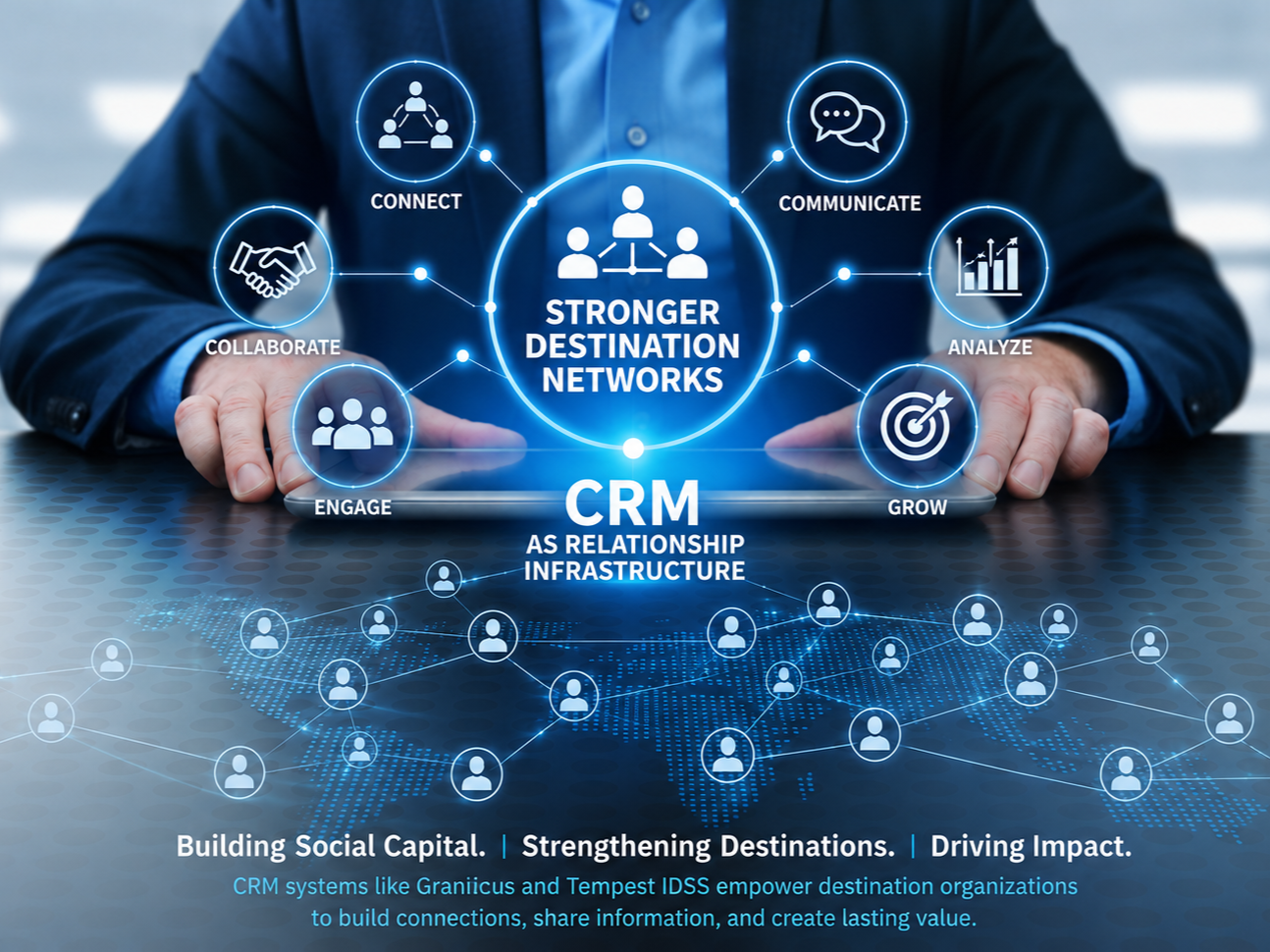
The role of CRM Systems in building structural social capital.
Point 1: CRM Systems Create Network Visibility
I’ve been around long enough to remember when CRM systems weren’t necessarily commonplace in our industry. Information was held in antiquated, often hard to locate spreadsheets and in many cases, vital information lived in the head of a specific employee. That is great for that employee, but less so for the organization if and when that person moves on to another job or is out of office for a specific amount of time. When those staff members, leave the managerial social capital leaves with them, which negatively impacts broader stakeholder engagement.
Your CRM creates what is essentially a centralized networked map of your stakeholders and all records of interaction with them at various levels:
Hotels
Attractions
Meeting Planners
Community Organizations
Government Agencies
Tourism Partners
Are just a few of the key focus of The Who and what of your organization. In short, you cannot manage a destination network that you do not have visibility into.
Point 2: CRM Systems Institutionalize Relationships
As mentioned in the previous section, staff turnover is common at most all organizations and when staff members leave, there is often a fair amount of knowledge, institutional and otherwise that leaves with them. When this happens, that trust that was previously build up along with the context of given relationships. The resulting effect here is that those relationships in many cases but be entirely rebuilt. This is especially the case in our industry the loss of relationship can be significant if there is no infrastructure in place to house the information that specifically employee had with them.
CRM systems when properly structured provide have the ability to transform individual relationships into organization relationships. When this happens, the following takes place:
The relationship no longer belongs to the employee and the employee only
That relationship belongs to the entire organization, thus building managerial social capital (which we will discuss in future posts)
CRM systems help to convert personal capital into organizational capital
Point 3: CRM Systems Improve Information Flow
A healthy destination network is one where information has little to no constraints and information moves through it smoothly. Structural social capital is strengthened when information reaches stakeholders efficiently, such as the following:
Event opportunities
Co-op marketing programs
Industry research
Legislative updates
Meeting leads
These systems also allow for:
The segmentation of audiences
Deliver reliant information to stakeholders
Track their levels of engagement and activity
Identify gaps in communication
In short, the flow of information of lack of it can tell us numerous things, specifically how poor information flow weakens social capital, and opposite of that how strong information flow increases the strength of social capital.
Point 4: CRM Systems Reveal Network Gaps
Now we’ve talked about thus far what these systems allow us to see and act upon, but what we often look past is the gaps that these systems reveal about our membership groups. Specifically lets think about the below:
Which stakeholders are not engaging
Which industries are underrepresented
Which geographic areas are lacking participation
Which partners are only interacting once per year
Insights such as the above provided by your CRM can provide the organization evidentiary support as to how to assess the overall health of the individual organization as well as the larger network and allow for you to intervene and understand why these organizations are engaging less with you or in some cases not at all.
Thought leading destination organizations and their CRM providers should be using these systems to create scoring mechanisms/frameworks that can tell you in real time the likelihood of what is commonly referred to as “Churn” which is when organizations leave the structure entirely and do not contribute further.
The most successful destination organizations will stop viewing CRM platforms as technology systems and begin viewing them as social infrastructure. Systems such as Simpleview/Granicus CRM , Tempest IDSS, and emergingly Salesforce and Hubspot platforms are not merely databases. They are the digital architecture through which destination relationships are maintained, information is exchanged, collaboration is coordinated, and social capital is developed. In an increasingly complex tourism ecosystem, structural social capital may be one of the most valuable assets a destination possesses—and CRM systems are increasingly where that asset is built, managed, and sustained.
In part two of the series, we will further explore further concepts related to how CRM systems foster the development and management of structural social capital.
