

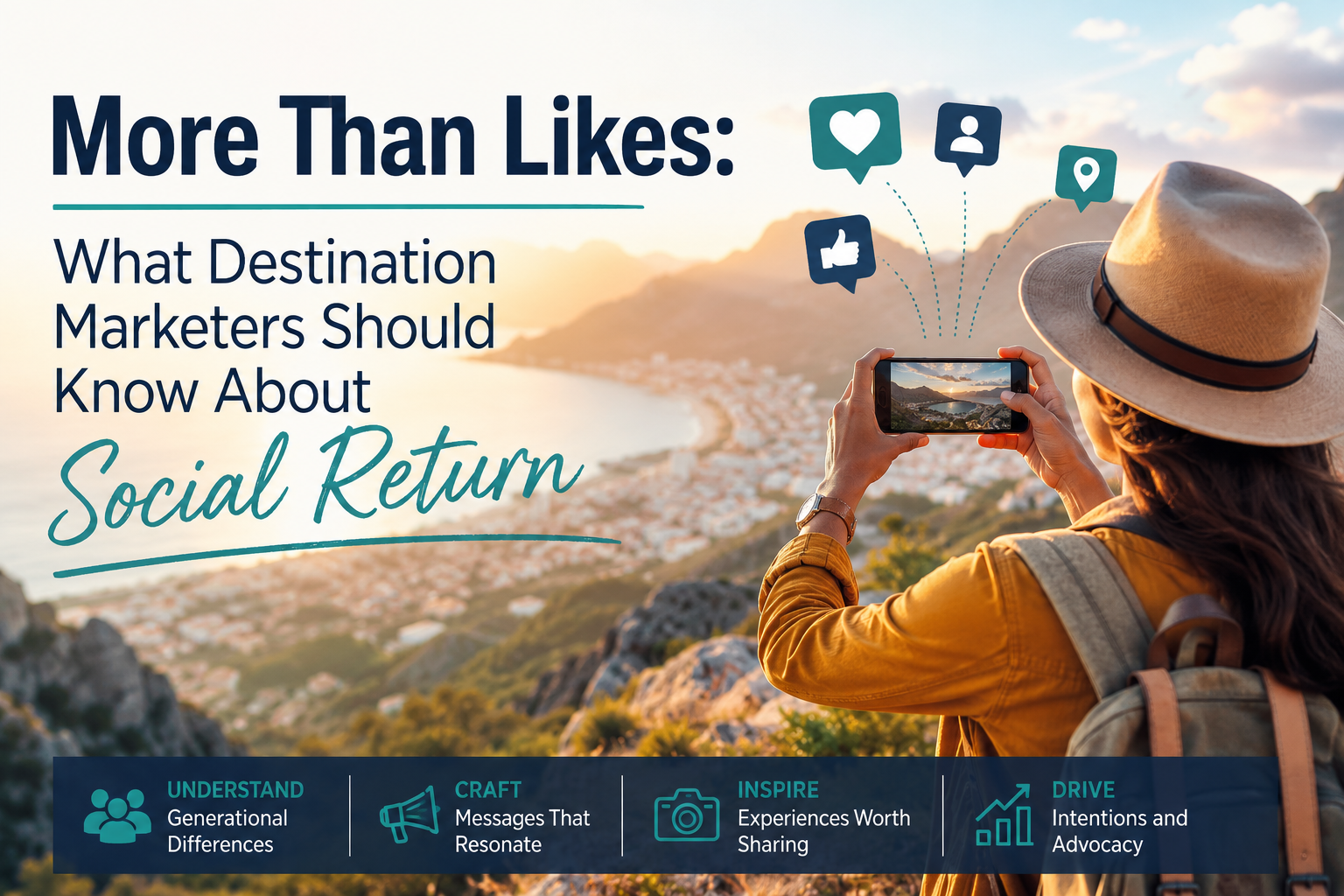
More Than Likes: What Destination Marketers Should Know About Social Return
Traditionally, destination marketing organizations have measured digital marketing success through metrics such as: impressions, website visits, bookings, traveler spending and of course economic impact. And as we can attest personally here at Greater Insights, all of the aforementioned metrics have tremendous merit collectively as well as individually.
But I recently stumbled upon an interesting study by the team at the University of Georgia that suggests there is another influential factor in how travelers making travel decisions and marketing success is measured.
The authors of the study refer to this influencing phenomena as “Social Return.” Simply defined, social return is “ the anticipated status boost earned through social media posting.
Another way to think of this would be to flip the normal questions travelers ask during the planning phase...
Instead of asking themselves:
"Where do I want to go?"
They instead think to themselves:
"What does going there say about me?"
For destination marketers, that's an important distinction. It becomes more about, how can visiting this destination increase or enhance my status among my network of followers, or in the opposite, how can visiting this destination decrease my status among my network of following.
Do I have your attention yet? No? Well, keep reading, it gets more interesting.
What is Social Return?
Let’s briefly dive into the concept a bit more.
It's about social currency.
At its core, the concept states that a traveler may choose a destination(s) because visiting this place helps them appear:
daring or fearless
worldly or experienced
in-the-know
unique
well-traveled
Post or during the trip, when they post photos or videos, they receive something that has enormous value:
recognition from peer groups and friends
igniting conversations
feeling a great sense of validation.
an increased sense of status
in effect, the destination becomes part of their personal brand.
Stay with me… I’m almost there.
The Research
To dive a bit more into the study and to understand the findings, there Researchers surveyed more than 2,800 travelers across a number of countries while studying the travel intentions toward destinations including:
France
United States
Cuba
Slovenia
Instead of asking only if people wanted to visit these destinations, the researchers examined whether the anticipated social value or social return of visiting influenced travel intentions.
The answer was thought provoking to say the least.
Across nearly each destination that was studied, higher perceived social return increased the likelihood that someone intended to visit.
Specifically, as it relates to destination marketing organizations, this changes our thinking slightly in terms of our thoughts around destination image.
I promise I am getting there.
The Biggest Finding for DMOs
Another major finding for the study was that amongst the four generations studied, they each had different outcomes in terms of how their intention to visit was affected.
That matters enormously for destination marketing.
Let’s discuss more below.
Baby Boomers
Researchers found this group reported the lowest social return scores, and social return had the weakest influence on whether they intended to visit a destination. This should be a major shocker as the boomer generation has different goals and different ways of achieving those goals especially when compared to younger generations. They aren’t specifically concerned with status and how they are perceived by peer groups as far as actors that influence whether they book a trip.
What this means
Think about this and the remainder of the groups from a media perspective. Specifically, how you and/or your agencies evaluate and ultimately deploy media strategies designed to increase awareness and visitation. For this group, traditional messaging still matters.
Focus on:
comfort
culture
heritage
service
relaxation
accessibility
Rather than creating "Instagram worthy moments," create confidence.
Generation X
Gen X still responds to social return, but with a little nuance.
The research suggests social return influences Gen X particularly when considering well-known, established destinations like France and the United States. So this group prefers a certain amount of familiarity with more popular well-known destinations.
Marketing implication
Highlight:
iconic experiences
authentic local culture
premium experiences
trusted reputation
This audience wants experiences worth sharing—but they don't necessarily need to be unconventional. So, from a planning perspective, highlighting the obvious in many ways works best for this group.
Millennials
Now I told you earlier it would get interesting… and here is where it does!
Millennials showed the strongest relationship between social return and travel intention, especially for less conventional destinations such as Cuba and Slovenia.
They appear motivated by destinations that help them:
discover something before everyone else
stand apart
experience something unique
tell an interesting story
Marketing implication
Instead of the message being:
Visit our destination.
The message or call to action becomes:
Be among the first.
Discover what others haven't.
Experience something unexpected.
Millennials often seek distinction. Think about that in terms of the execution of say a media campaign across display, native video etc. Your call to action goes from “click here” “learn more” “visit xx destination” to “Be Among the First” or “Experience the Unexpected.” A much more potentially compelling way to gain the attention of potential travelers.
Generation Z
Gen Z presents an interesting nuance.
The study found that social return was less influential for conventional destinations, suggesting younger travelers may place less value on posting trips that everyone else has already taken.
For mainstream destinations, simply being famous may no longer be enough. Pay attention here big budget destinations… you know who you are…
Marketing implication
We’ve all seen this in some form or fashion in that, if you're a well-known destination, don't market your popularity.
Market your hidden experiences. Sometimes referred to the “off the beaten path” type of experiences.
Show:
neighborhoods locals love
unexpected attractions
behind-the-scenes experiences
niche events
authentic community interactions
Help visitors discover something they can't easily copy. This is especially the case for destinations such as Central Florida where the Disney’s Universal and Seaworld’s of the world command great attention from travelers and rightly so to an extent.
But there exist tremendous opportunity to promote the Milk District in Orlando, or Historic Sanford In Seminole County, or explore unique dining options along the Kissimmee Latin Culinary Trail.
What This Means for Destination Marketing
One campaign should not serve every generation. Different strokes for different folks basically.
Each individual destination can tell multiple stories.
A quick example:
A historic downtown such as Historic Sanford might be marketed as:
Heritage and architecture for Boomers
Culinary exploration for Gen X
Hidden local gems for Millennials
Creator-worthy neighborhoods for Gen Z
The destination hasn't changed.
The narrative has.
The Opportunity for DMOs
As destination marketers, our job is not simply to just to inspire travel—it is to understand what motivates people to choose one destination over another. As this study demonstrates, the social value visitors associate with a destination can be just as influential as its attractions, amenities, or accessibility.
The question for every DMO is a thought provoking one: Are you marketing places, or are you marketing the stories people want to talk about themselves?
Destinations that recognize this shift and align their branding, content, media execution and visitor experiences with the evolving motivations of each generation will be better positioned to earn not only more visitors, but also more advocates who amplify their destination through authentic, trusted networks.
