
Trust Behind the Strategy Series: Co-Creation Begins Before the Brainstorming Session
This article is part of The Trust Behind the Strategy, a Greater Insights series inspired by my conversation with Nerissa Okiye about stakeholder relationships, co-creation, and Martin County’s “AI Means More Here” campaign.
So I know some of you may be thinking… what is this co-creation thing? Well lets start with a basic definition for the term before we dive deep in.
“Co-creation is defined as a collaborative process that facilitates meaningful participation among stakeholders, leading to shifts in power and agency, particularly in healthcare contexts. It involves shared decision-making and the incorporation of community values to enhance engagement and address social barriers.”
Now its easy to think that the process of co-creation has to include the stakeholders in every decision, and at every point. Well thats not always the case!
Co-creation does not necessarily mean inviting every stakeholder into every creative meeting. It can also begin when continuous stakeholder listening shapes how a DMO understands community needs, identifies problems, and develops solutions.
In that sense, the process starts long before a campaign is conceived.
It begins through the ongoing work of communicating with stakeholders, understanding their priorities, and building trust over time. This prepares the relational ground for future collaboration. The DMO is not reaching out only when it needs approval, participation, or financial support. It is maintaining relationships because stakeholder knowledge is essential to how the organization understands and serves the destination.
Co-Creation Is More Than a Meeting
When organizations talk about co-creation, the conversation often focuses on a specific activity: a workshop, focus group, planning session, or stakeholder advisory committee.
Those activities can be valuable, but they are only part of the process.
A DMO may bring stakeholders together for a brainstorming session and still fail to achieve meaningful co-creation. If participants are invited after the important decisions have already been made—or if their input has little chance of influencing the outcome— thats more about consultation and less about the process of collaboration.
Conversely, stakeholders may not participate in every campaign meeting. As you can imagine, the demands on their time are endless and they have to be running their own businesses separately. With actively listening by the DMO and constant communication, their perspectives can still influence the final strategy if the organization has listened to them consistently.
The important question is not simply:
Were stakeholders in the room?
The better question is:
Did stakeholder knowledge meaningfully shape how the organization understood the opportunity and developed its response?
That distinction is important in examining Martin County’s “AI Means More Here” campaign.
The campaign was largely developed by the DMO team. It was not created through an open process in which every local stakeholder helped select the concept, write the messaging, or design the creative.
Under a strict definition, it would be difficult to describe the campaign as fully participatory co-creation.
But it would also be inaccurate to characterize it as disconnected, top-down marketing.
The campaign emerged from an organization with extensive knowledge of its community—knowledge developed through costant and ongoing stakeholder conversations, strategic planning, research, focus groups, public-sector relationships, and ongoing engagement with local organizations.
The stakeholders may not have written the campaign, but their needs, challenges, values, and identities were present within it.
I describe this as relationship-informed co-creation.
Relationship-Informed Co-Creation
Relationship-informed co-creation occurs when “knowledge accumulated through ongoing stakeholder relationships becomes embedded in how an organization thinks and acts.”
It depends on three conditions:
The organization listens continuously rather than only when it needs support.
Stakeholder knowledge influences how problems and opportunities are understood.
The organization remains accountable by explaining how stakeholder interests affected the decision.
This approach does not replace more direct forms of participation. Some decisions—particularly those with significant community consequences—require stakeholders to have a more active role in designing the solution.
There can be however, too many cooks in the kitchen as the old adage goes. Not every campaign can or should be developed by committee. Attempting to include every stakeholder in every decision can slow progress, blur accountability, and produce ideas designed to satisfy everyone rather than distinguish the destination. Additionally individual actors within the community may only think of themselves and how the outcomes best benefit their organization.
The responsibility of the DMO is to know when direct participation is necessary and when accumulated stakeholder intelligence provides an appropriate foundation for action. Achieving the balance here can be tricky, but is absolutely necessary.
Listening Becomes Organizational Knowledge
Throughout my conversation with Nerissa, she demonstrated a detailed understanding of what different parts of the Martin County community were experiencing. In many ways, we can refer to the knowledge gained by Nerissa and her staff as a form of intellectual capital. Another concept we will delve into at a later date.
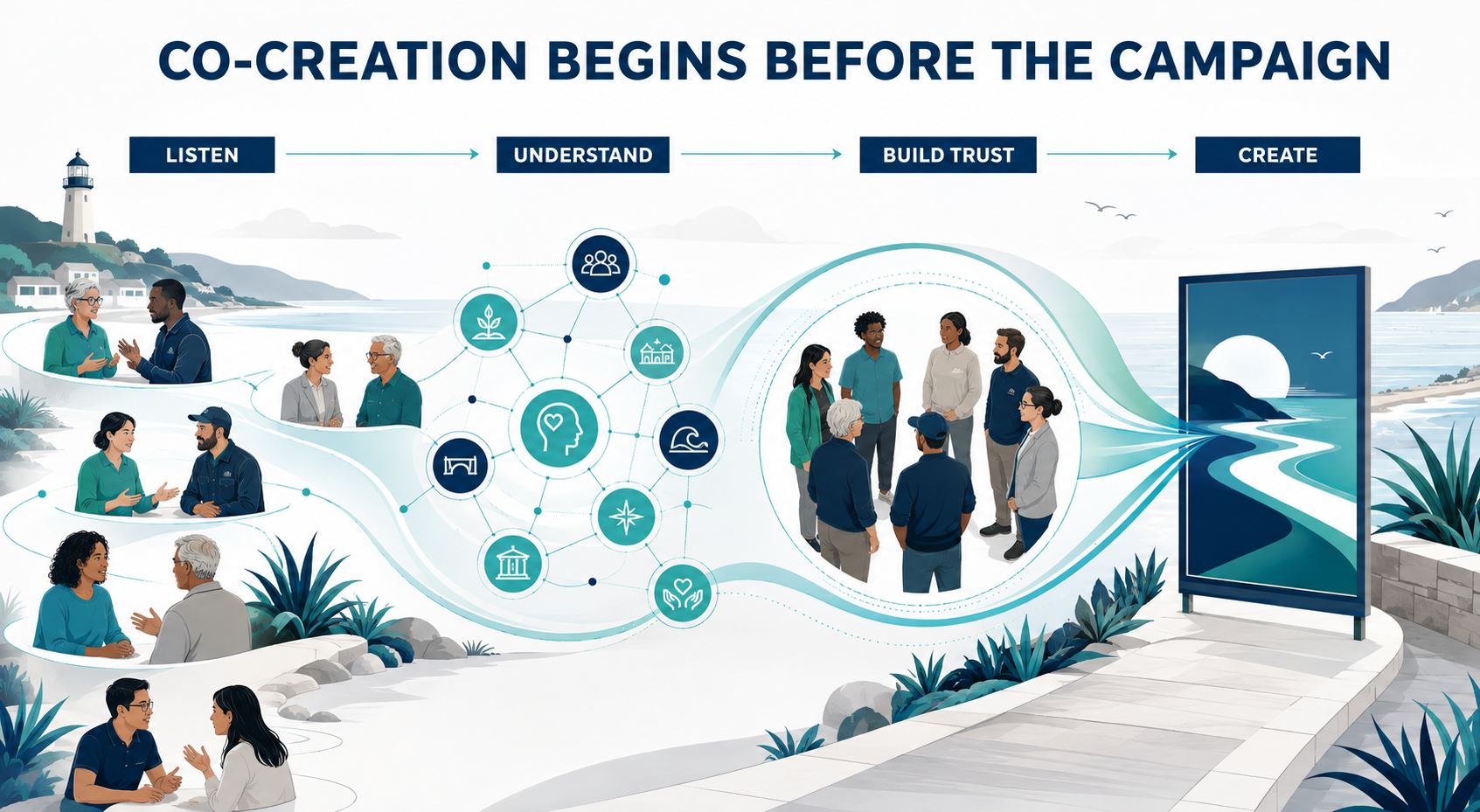
She spoke about the priorities of lodging partners, arts organizations, downtown businesses, environmental teams, accessibility advocates, government officials, and other community groups. That understanding was not produced by a single campaign meeting. It was developed through repeated interaction over time.
Every stakeholder conversation contributed another piece of information about the destination:
What challenges are emerging?
Which organizations need greater visibility?
Where are resources limited?
What experiences distinguish the community?
Which issues matter to residents?
Where might collaboration create greater value?
When those insights are captured and connected, stakeholder engagement becomes more than relationship maintenance. It becomes a source of destination intelligence.
Nerissa summarized this listening posture through a series of direct questions:
“What are your challenges? What improvements have you seen? What are your expectations for us? How can we actually help?”
Those questions shift the relationship away from transactions. The DMO is not beginning with “How can you support our campaign?” It is beginning with “What are you trying to accomplish, and how can we help?”
That approach allows stakeholder knowledge to influence strategy before a formal project begins.
Co-Creation Still Requires Accountability
There is also a risk in defining co-creation too broadly. An organization cannot claim that a decision was co-created simply because it has good stakeholder relationships.
Listening must lead to evidence of influence.
Stakeholders should be able to see how their perspectives shaped the organization’s understanding, priorities, or actions. When a suggestion cannot be incorporated, the DMO should explain why. When an idea is tested, participants should hear what happened. When community contributions create value, the people and organizations responsible should receive recognition.
Closing the loop is what separates meaningful engagement from stakeholder theater.
A relationship-informed approach should therefore include five practices:
Listen continuously.
Do not wait until approval or participation is needed.Capture what is learned.
Stakeholder knowledge should become organizational knowledge rather than remain in one person’s inbox or memory.Identify patterns.
Look beyond individual requests to understand broader destination needs.Choose the appropriate level of participation.
Some decisions require direct collaboration; others can be responsibly informed by existing relationships and research.Close the loop.
Show stakeholders how their perspectives influenced the outcome—or explain why a different direction was taken.
Co-Creation Begins Before the Campaign
The lesson from Martin County is that co-creation should not be treated as a single event within the campaign-development process.
It is an ongoing organizational capability.
It is built through repeated conversations, shared learning, responsiveness, and trust. Those relationships give the DMO a deeper understanding of the destination and allow stakeholder perspectives to influence ideas before those ideas have names, budgets, or creative concepts.
The people around the table still matter. But so does everything the organization learned before entering the room.
That is why meaningful co-creation often begins long before the brainstorming session.
The next article in The Trust Behind the Strategy examines how stakeholder conversations become destination intelligence—and why listening may be one of a DMO’s most valuable strategic capabilities.
