

Lessons in Destination Leadership from Martin County
Destination marketing organizations have traditionally been evaluated by what they produce: marketing campaigns, visitor engagement, room nights, economic impact, and other measurable outcomes.
These indicators matter. They help demonstrate the value of tourism and justify the resources invested in destination promotion.
But they don't tell the entire story.
Some of the most important work a DMO performs happens long before a campaign launches or a visitor arrives. It happens through conversations, relationships, shared problem-solving, and the ability to bring people together around a common vision for the destination.
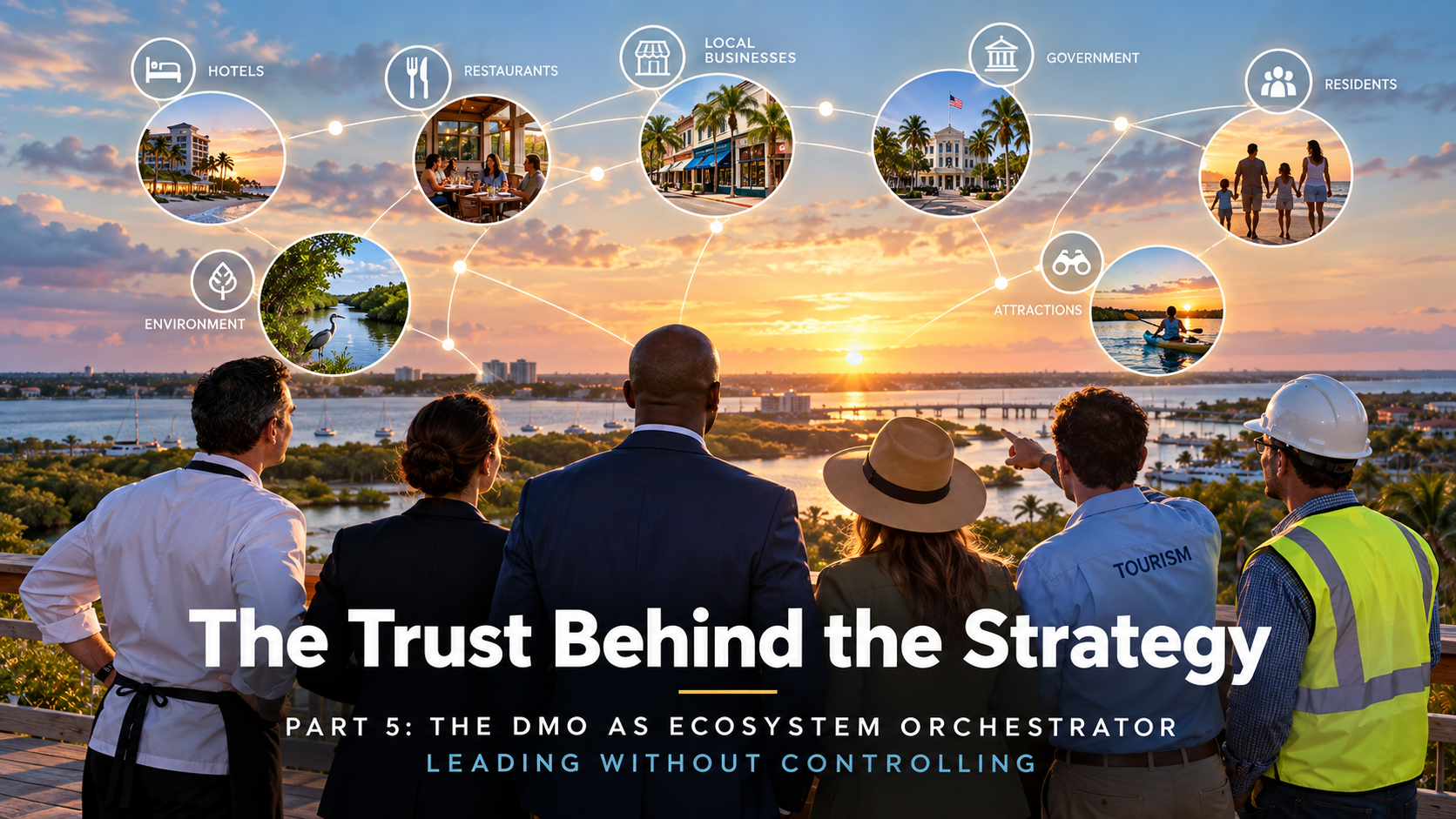
The Trust Behind the Strategy
And increasingly, I believe this is where the future of destination leadership resides.
The modern DMO must be more than a destination promoter. It must become an ecosystem orchestrator.
From Destination Marketing to Destination Orchestration
A destination is not a single organization. It is an interconnected ecosystem of hotels, attractions, restaurants, small businesses, government agencies, community organizations, residents, and countless other stakeholders. You’ve heard me refer to this as a complex adaptive system or similar in previous posts.
Each participant brings different priorities, resources, perspectives, and expectations.
A hotel may prioritize occupancy. A restaurant may be concerned about seasonal demand. Local government may focus on economic development and infrastructure. Residents may be thinking about quality of life and preserving the character of their community.
These interests are not always aligned. In fact, most often they are not.
Yet the success of the destination depends, at least in part, on how effectively these different participants work together.
This presents an interesting leadership challenge for DMOs.
Unlike a traditional corporation, a DMO does not have direct authority over most of the organizations that shape the visitor experience. It cannot require a hotel to participate in a campaign, compel a restaurant to embrace a new initiative, or dictate how community partners should prioritize their resources.
Instead, it must influence, coordinate, and build alignment.
In other words, DMOs are expected to lead an ecosystem they do not control.
And that requires a very different set of leadership capabilities.
Trust Is the Infrastructure of Collaboration
Throughout this series, I've explored the role of trust in destination innovation, co-creation, stakeholder listening, and navigating disagreement.
Ecosystem orchestration brings these ideas together.
Consider what happens when a DMO introduces a new destination initiative.
The traditional approach might focus on communicating the opportunity, recruiting participants, and measuring engagement.
But participation alone does not necessarily indicate meaningful collaboration.
A stakeholder may attend a meeting without feeling heard. A business may participate in a campaign without understanding its broader purpose. A community partner may support an initiative while remaining skeptical of the organization's long-term intentions.
These distinctions matter.
Trust influences whether stakeholders share information, contribute ideas, commit resources, and remain engaged when outcomes are uncertain.
It also influences whether they are willing to participate in initiatives that may not deliver an immediate individual benefit but could create value for the destination as a whole.
This is where social capital becomes particularly important.
Relationships within stakeholder groups can strengthen cooperation and reinforce shared interests. Connections across different organizations can introduce new perspectives, resources, and opportunities. Relationships with institutions and decision-makers can help translate collaborative ideas into meaningful action.
In social capital theory, these relational dimensions are commonly described as bonding, bridging, and linking social capital.
For destination leaders, however, the practical implication is straightforward:
The strength of a destination's collaborative capacity depends not simply on how many stakeholders are connected, but on the quality and purpose of those connections.
A DMO's responsibility is not merely to maintain a network.
It is to help that network function.
The Martin County Perspective
One of the lessons I've taken from examining destination leadership in Martin County is the importance of understanding the destination as a collection of relationships rather than simply a collection of tourism assets.
The destination's value is not defined exclusively by its beaches, natural resources, accommodations, attractions, or visitor experiences.
It is also shaped by the people and organizations responsible for sustaining those experiences.
This creates an important distinction between promoting a destination and helping it succeed.
Promotion communicates value to an external audience.
Orchestration helps stakeholders collectively create, preserve, and strengthen that value.
For a destination such as Martin County, where community character and the natural environment are central to its identity, this distinction is especially relevant.
Tourism success cannot be considered entirely separate from community priorities, environmental stewardship, or the long-term interests of local businesses.
The DMO therefore occupies a unique position.
It can serve as a connector between organizations that might otherwise operate independently. It can help translate different stakeholder perspectives into shared priorities. And it can create opportunities for collaboration that extend beyond individual marketing activities.
Importantly, this does not mean every stakeholder must agree.
As I discussed in the previous installment, co-creation is not consensus.
Effective orchestration requires the ability to acknowledge competing interests while maintaining enough trust for stakeholders to continue working toward shared objectives.
That is a leadership capability, not simply a marketing function.
Relationships Need More Than Good Intentions
There is another dimension of ecosystem orchestration that deserves greater attention.
DMOs often invest considerable effort in building relationships, but relationship management can remain informal, personality-driven, or heavily dependent on individual staff members.
A stakeholder may have an excellent relationship with a particular DMO employee. But what happens when that employee leaves?
How does the organization retain the knowledge developed through years of conversations?
How does it identify when a previously engaged partner becomes disconnected?
And how does it determine whether its stakeholder relationships are actually creating mutual value?
These questions become increasingly important as DMOs assume broader responsibilities.
The answer is not to make relationships transactional or reduce trust to a numerical score.
Rather, it is to recognize that relationship development should be treated as an organizational capability, not merely an individual talent.
This means thinking more intentionally about how DMOs listen to stakeholders, document shared priorities, communicate outcomes, coordinate engagement, and sustain relationships over time.
There is a meaningful difference between tracking stakeholder participation and understanding stakeholder success.
An organization may know how many partners attended an event or participated in a campaign without fully understanding whether those partners achieved anything valuable through the relationship.
That gap represents an opportunity to rethink how destination organizations approach partnership management.
It also raises a question worth exploring:
What would change if DMOs managed stakeholder relationships with the same strategic discipline that businesses apply to customer success?
Not because stakeholders should be treated simply as customers, but because effective relationship management requires an ongoing understanding of needs, expectations, outcomes, and mutual value.
For DMOs, that understanding could strengthen both organizational performance and destination-wide collaboration.
Leading Without Controlling
Perhaps the most important characteristic of an ecosystem orchestrator is the ability to create alignment without relying on formal authority.
This requires several forms of leadership.
It requires credibility, because stakeholders must believe the organization understands their interests.
It requires transparency, because not every decision will benefit every participant equally.
It requires consistency, because trust is strengthened through repeated interactions rather than isolated gestures.
And it requires humility, because the DMO must recognize that valuable knowledge and expertise exist throughout the destination ecosystem, not exclusively within its own organization.
The objective is not to position the DMO at the center of every decision.
It is to help create the conditions in which stakeholders can collaborate effectively, sometimes even without the DMO's direct involvement.
In that sense, successful orchestration may produce outcomes that are difficult to attribute to a single organization.
A new partnership emerges. A shared problem gets resolved. Businesses exchange knowledge. Stakeholders coordinate around a common challenge.
The DMO may have helped establish the relationships that made these outcomes possible without being directly responsible for every result.
Traditional performance measures do not always capture that contribution.
But its value is real.
Rethinking What Destination Leadership Means
The evolution from destination promotion to ecosystem orchestration does not diminish the importance of marketing.
It expands the context in which marketing operates.
A compelling destination campaign may generate awareness and demand. But the long-term competitiveness of a destination also depends on the relationships, institutional capacity, and collective decisions that shape the visitor and resident experience.
This suggests that destination leadership should be evaluated not only by what the DMO delivers directly, but also by what it enables others to accomplish together.
That is a more complex responsibility.
It is also a potentially more consequential one.
As the expectations placed on destination organizations continue to evolve, the ability to build trust, bridge stakeholder interests, and sustain collaborative relationships may become just as important as the ability to develop an effective marketing campaign.
Because ultimately, a destination's success is not created by one organization acting alone.
It emerges from the collective actions of an entire ecosystem.
And the most effective destination leaders understand that their role is not to control that ecosystem, but to help it thrive.
Coming Next in The Trust Behind the Strategy
Part 6: Beyond Membership: What Does Stakeholder Success Actually Look Like?
If relationships are essential to destination performance, how should DMOs understand and evaluate their value?
In the next installment, I'll explore the distinction between stakeholder participation, membership, engagement, and success—and why the future of DMO partnership management may require a more intentional approach to creating mutual value.
